Interest Rates and Australian Households in 2026
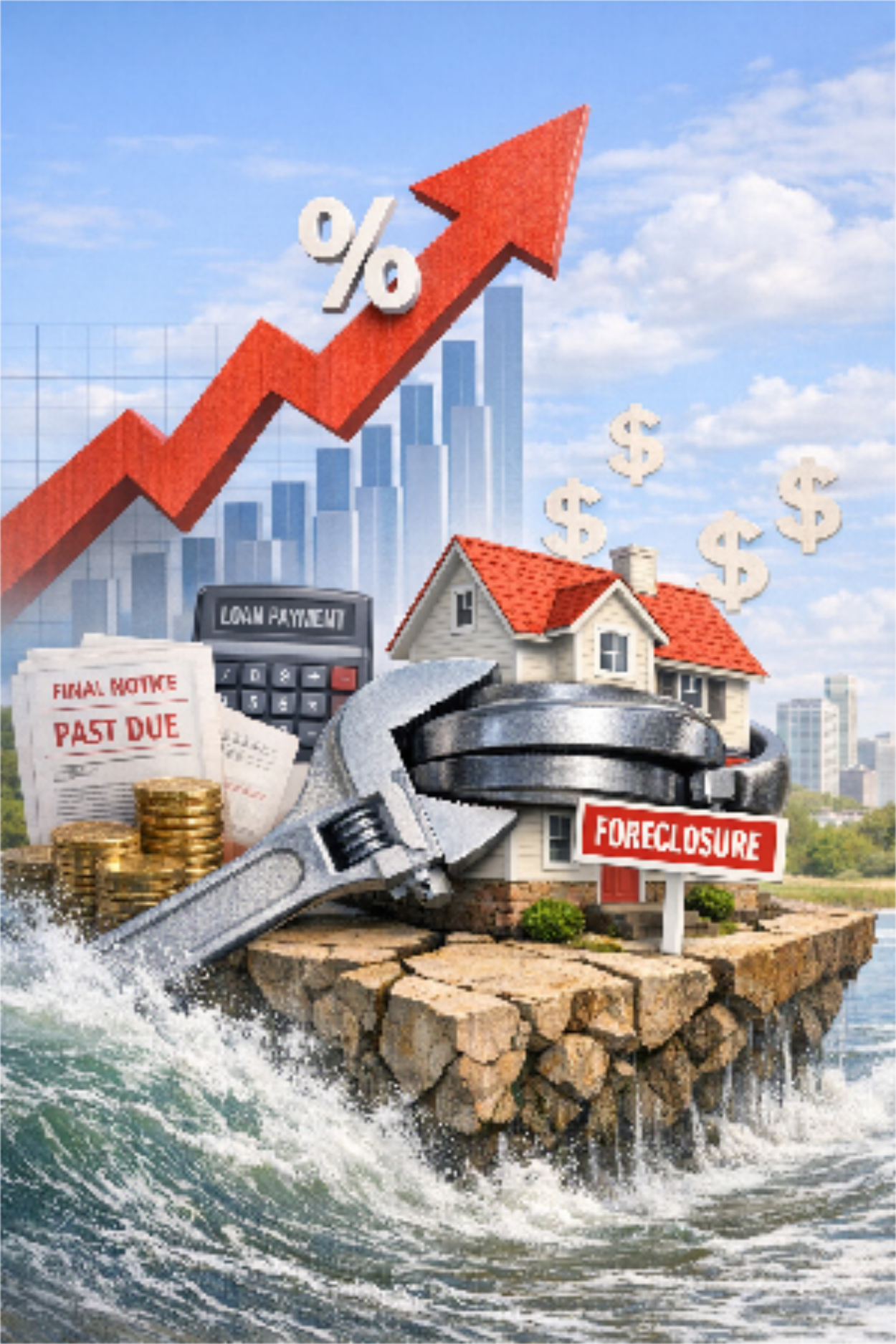
Australian households are having to adapt quickly as interest rate settings continue to influence mortgage repayments. For many families, fixed-rate transitions have moved from financial theory into monthly reality.
The practical impact is visible in discretionary categories: fewer large consumer purchases, more demand for value retail, and growing attention to energy and utility bills. This pressure is not evenly distributed, with outer-suburban and regional borrowers carrying different exposure profiles.
The lack of clear policy from the Commonwealth Government has left it to a poorly prepared Reserve Bank, an institution with essentially one blunt instrument to try to control what seems uncontrollable. Australia needs a larger conversation about how we manage inflation in a modern, globally connected economy. That conversation needs to happen now, at the intersection of inflation control and household resilience.
The next Reserve Bank meeting will show whether the Governor understands the changing world we live in, or whether the institution is stuck in the past. Right now, an ordinary Australian like me has almost as much chance of guessing where inflation and growth are headed as any economist—or the Reserve Bank itself.
Will the Government recognise that now is not the time to squeeze wages further? Or will it cave to the mentality of: “I just want to stay Prime Minister—who gives a s*** what happens to the country?”
The decline of the Reserve Bank’s power
In the distant past, manipulating interest rates could help curb inflation. But the world of the 2020s is very different from the 1990s. Globalisation, large-scale population movement, and advanced economies shifting from being producers to being mainly consumers have turned interest rate policy into a wooden spear in a nuclear age.
Economists struggled to forecast accurately even in the 1800s and 1900s, when global trade moved at the speed of month long voyages. Today, we move tens of thousands of tonnes of goods on a single ship thousands of ships every day. Yet we still act as if a single lever (the cash rate) can steer prices in an economy shaped by global supply chains, geopolitics, energy markets, and housing constraints.
Even the way we talk about inflation feels detached from lived reality: we estimate it using a theoretical “basket” of goods that changes over time, while policy models often simplify or outright omit hard to measure forces because they are difficult to quantify. When the measurement is noisy and the models are incomplete, what chance does the public have of trusting the next confident forecast?
When was the last time you heard Treasury or the Reserve Bank give precise numbers for growth and inflation and then hit them? It feels like “fool me once, fool me twice” except we keep accepting confident projections that quickly date out.
After COVID, the Reserve Bank signalled that rates would not rise until 2024 (a message many households interpreted as reassurance). That guidance was later overtaken by events as inflation surged and rates rose rapidly. Whether you call it a forecasting error or a communications failure, bad guessing, or just stupid ordinary borrowers paid the price.
Now we have a Treasurer who says inflation is under control “nothing to see here” and then, the next week, points to a conflict overseas as the reason inflation and rates are soaring. Meanwhile, government spending keeps expanding. One way this shows up is in the labour market: the Australian Industry Group has argued that, in the year to the September quarter of 2024, “non-market” industries (public administration, healthcare and social assistance, and education and training) accounted for five in six (85%) of jobs created, with the private sector broadly flat. This raises an uncomfortable question about how much of our resilience is being propped up by taxpayer-funded activity.
The NDIS is also expanding rapidly, and its long-term cost trajectory is now a major budget issue. The scheme may be necessary but it still needs hard scrutiny, transparency, and better outcomes for the money spent, the waste needs to stop.
So what do we do?
It has to stop. Australia has to start making things again. You cannot run a country on services alone while importing most of what you consume. What do we make in Australia now? We export coal, iron ore, and other raw materials; we grow food; and that’s a big part of the story. Beyond that, too much of the economy has shifted into services.
Services matter but they should sit on top of a stronger base: manufacturing, value added resources, agriculture, and high end technology. We still do world class science and innovation, but too often we commercialise it elsewhere, selling rights and know-how offshore instead of building local industry that captures the jobs, capability, and profits here.
When will we get politicians who want to improve the country rather than simply win the next election? Too often, their decisions track the news cycle instead of the long term work of governing.
A classic example, look at the 2026 South Australian election and the way victory gets marketed afterwards. Premier Peter Malinauskas can point to a landslide in seats, but the headline primary vote was only around 37%. That gap matters. A big seat majority in a preferential, single-member system does not automatically mean “most people wanted this government”; it often means the opposition collapsed, votes fragmented across minor parties and independents, and preferences then flowed in a way that converted a plurality into dominance.
And this is where politicians (and the media) abuse the language of “mandate”. They fall back on a two-party preferred story as if it reflects genuine enthusiasm. In reality, two party preferred is often just a tidy way of describing the least worst outcome once preferences are distributed: not “I wanted them”, but “someone has to govern so I preferred them to the other party at the final count”. Preferential voting was introduced to stop conservatives (and later, everyone) being punished by vote splitting under first past the post, and it does tend to produce clearer single party outcomes. But clarity in parliament is not the same thing as consent in the community. If we ran lower houses on a more proportional basis, a great many governments in recent history would have been minority governments, forced to negotiate, share power, and justify decisions rather than declaring a blank cheque every time the seat tally looks impressive.
That’s the point: a government can be legally formed, stable, and entitled to govern without pretending it has majority moral authority. A 37% first preference vote should be a warning light, not a victory lap. It should push any premier to govern with restraint, to listen harder, and to focus on outcomes instead of slogans.
While I don’t agree with everything One Nation says and in the past they have been very fractured, but the country is becoming too divisive. Policies One Nation regularly campaign on are concerns shared by many Australians:
- Reducing immigration levels and tightening eligibility (often framed as easing pressure on housing, wages, and infrastructure).
- Cutting government waste and tightening eligibility/targeting so support goes to people who genuinely need it.
- “Australians first” industry policy: backing local manufacturing, apprenticeships, and sovereign capability in critical supply chains.
- Energy security, including domestic gas reservation/strategic reserves, and a stronger focus on reliable dispatchable generation.
- Opposing the “premature” closure of coal and gas power stations without proven, scalable replacements in place; extending coal generation where needed.
- Repealing the federal ban on nuclear power and developing nuclear as part of the long term energy mix.
- Reducing reliance on government funded activity as a substitute for productivity and arguing for tighter controls on big ticket programs (including NDIS reform in their platform).
Will any of this happen in my lifetime? Maybe not. But I want it to improve for my kids and their kids—because if we keep pretending short term politics is a strategy, we are handing the next generation a harder, smaller country.