Fuel Crisis: A Warning for Australia
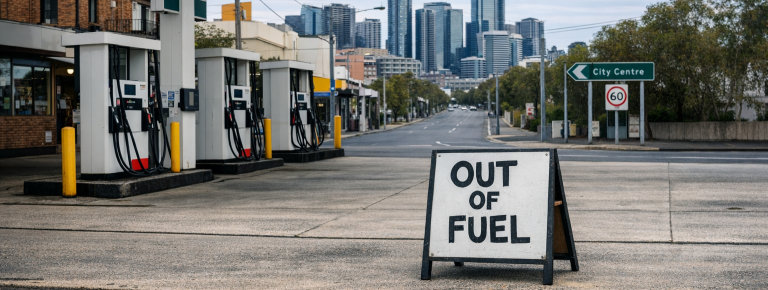
Australia is facing a fuel-supply squeeze that is now hitting regional communities, farmers, and supply chains. The latest reports suggest a system under pressure, with direct consequences for food production and national resilience.
A Nation Under Fuel Pressure
Recent reporting points to a broad and fast-moving supply problem:
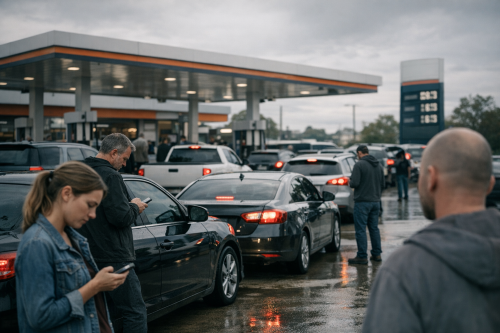
- Hundreds of service stations have reported diesel or unleaded outages.
- New South Wales, Victoria, Queensland, and Western Australia have each reported significant shortages.
- Regional areas are carrying a disproportionate burden because alternatives are often hours away. These are not isolated local disruptions; they indicate a national system operating with limited slack.
Why This Matters for Farmers
The fuel issue strikes at the heart of Australia’s food-production supply chain. Diesel is the lifeblood of the farming sector—you can’t just plug a tractor into the nearest wind turbine. Chris Bowen either doesn’t seem to get it, or he doesn’t care. It’s pretty hard to “work from home” if you’re a farmer: farmers create and build; they don’t just talk. Bowen can work from anywhere there’s a reporter, a mic, and a camera, but you can’t harvest a crop from the kitchen table.
Bowen seems too busy playing the international climate statesman rather than representing the Australian people. Talkfests won’t fix supply issues, and solar and wind don’t drive $350,000 harvesters—diesel does. But! If we could just harvest the wind coming from Canberra, there might be hope.
Diesel Shortages Halt Farm Work
Even if this isn’t strictly a supply issue, it’s certainly a logistics issue: diesel isn’t getting to where it needs to go, and politicians don’t seem to see the bleeding obvious. They might not have known what was about to happen when Trump hit Iran, but they should have been able to forecast the consequences and formulate a national response.
But three weeks on, they still have no realistic response. Instead, they’ve appointed yet another bureaucrat to coordinate with industry groups—so they can talk about what they should do, draw up a plan, and give it to Cabinet to review and decide whether it satisfies every bleeding-heart minority and the Greens before they implement it. Seriously—have these people ever had a real job? I mean one that actually does something.
A Structural Vulnerability
This latest crisis is yet another indication of how badly our governments have let Australians down. For decades, politicians have rushed to join international political “me too” movements, wanting to big-note themselves on the world stage.
One has to wonder: does it make sense to shut down your industry and manufacturing—and sell your farms down the drain—just so you can trot off to a meeting in China and say, “Look how good a partner we are; we buy everything our country needs to survive from you,” only to be laughed at?
Is this a wake-up call, or just a blip on Albo’s way to handing our country over to every minority with an axe to grind? I watched a video of Albo at a mosque in Sydney; he looked like a scared little boy, sitting there with his legs crossed while people spoke rubbish about our country. Bob Hawke would be rolling in his grave. Do you think he would be sitting at the feet of some cleric while being told how terrible our country is? I doubt it. For starters, he wouldn’t have been foolish enough to put himself in that situation—but if he were there, he wouldn’t have sat meekly while some cleric smacked his backside.
Bottom Line
This is no longer a theoretical policy risk. Fuel reliability now intersects with food security, regional economics, and household cost of living.
The immediate priority should be keeping diesel flowing to productive sectors, while building a more resilient long-term fuel strategy for Australia. And forget the per-capita carbon emissions argument: less than 1% is less than 1%. We could cut our total emissions to zero and it would have no effect at all. Except! We would become a third-world country—and that’s where we’re headed if we keep listening to Bowen and the Greens.
If Australia had spent just half of what we’ve spent on so-called green energy over the last 20 years on nuclear energy, we wouldn’t have power issues. Sometimes the real cost isn’t dollars—it’s the cost of backing the wrong horse. We’ve spent hundreds of billions (and continue to do so) on green energy and haven’t seen any tangible outcome from it, other than lining China’s pockets—paying them for technology we developed, then sold to them, so they could sell it back to us. Go figure.
This country needs real leaders, not little boys playing at politics. Albo and Bowen are an embarrassment. No wonder Trump ignored Albo for so long—he must really wonder about Australia if we elected Albo as our leader.